


Oscar Zárate emcees a march against ICE actions on Oct. 4, 2026, at the Sixth Street Bridge in Los Angeles. (Photo by Arthur Vartanian for The Valley Star News.)
Oscar Zarate: From Community Roots to Immigrant Rights Leadership
The air was cool and it was 7 p.m. in Southeast Los Angeles. Oscar Zarate, 30, had been home for two hours after attending a day-long community event, just long enough to pack his bag. Now he was hitting the road to Sacramento–six hours north for the Day of Action conference, where, as director of external affairs for one of California’s largest immigrant rights organizations, he would lobby state lawmakers. He locked the door behind him. To most people, the long, late-night drive would seem irregular, but to Zarate, it was part of the job.
Zarate’s role places him in the midst of immigrant rights advocacy in Los Angeles County, where coalition-building and political strategy shape the direction of local and statewide campaigns. He works with more than 100 coalitions, coordinating efforts between community and faith-based organizations, labor unions and policymakers to advance immigrant rights. His work with The Coalition for Humane Immigrant Rights (CHIRLA) prioritizes developing a pathway to citizenship, expanding immigrant protections and strengthening access to resources.
Zarate’s path into advocacy is rooted in his upbringing. Originally from Guerrero, Mexico, he moved to the United States at age 7 and grew up in Compton. He said his working-class background — not just his immigration status — shaped his commitment to social justice. His college attendance later led him into advocacy work. While attending the University of California, Santa Barbara, more than 120 miles from home, he joined Improving Dreams Equality Access and Success (IDEAS), an undocumented student organization and became involved in campus organizing.
Oscar Zarate, at age 5 in Guerrero, Mexico, displays a school project before immigrating to California. (Courtesy of the Zarate family.)

“Being around my peers and being active on campus got me interested in advocating and being active politically,” Zarate said.
That interest deepened through his participation in the UCLA Dream Summer program, where he interned with labor organizations including the Teamsters and Service Employees International Union (SEIU). The experience exposed him to movement-building beyond campus.

Oscar Zárate, second from left, at age 18 during his first internship with fellow interns and a Lynwood City Council member. (Courtesy of the Zarate family.)
Today, his work extends far beyond a single organization. Zarate helps coordinate efforts across multiple levels—local, statewide and national—bringing together groups with different priorities under shared campaigns. Among the most prominent is May Day, one of the largest annual immigrant rights mobilizations in Los Angeles.
Pedro Trujillo, director of organizing at CHIRLA, said Zarate plays a key role in coordinating those large-scale efforts.
“Events like May Day don’t happen without someone making sure everyone is aligned,” Trujillo said. “Oscar is one of the people doing that behind the scenes — making sure the strategy and the message come together.”
Zarate sees those moments as a show of collective strength.
“This is where we really flex our power,” he said. “It’s one of those events where we’re uplifting our demands and our vision for the movement.”
Trujillo added that Zarate’s ability to bridge grassroots organizing and policy work sets him apart.
“Oscar understands how to build power from the ground up, but he also knows how to translate that into policy,” he said. “That’s rare. A lot of people can do one or the other — he’s able to do both.”
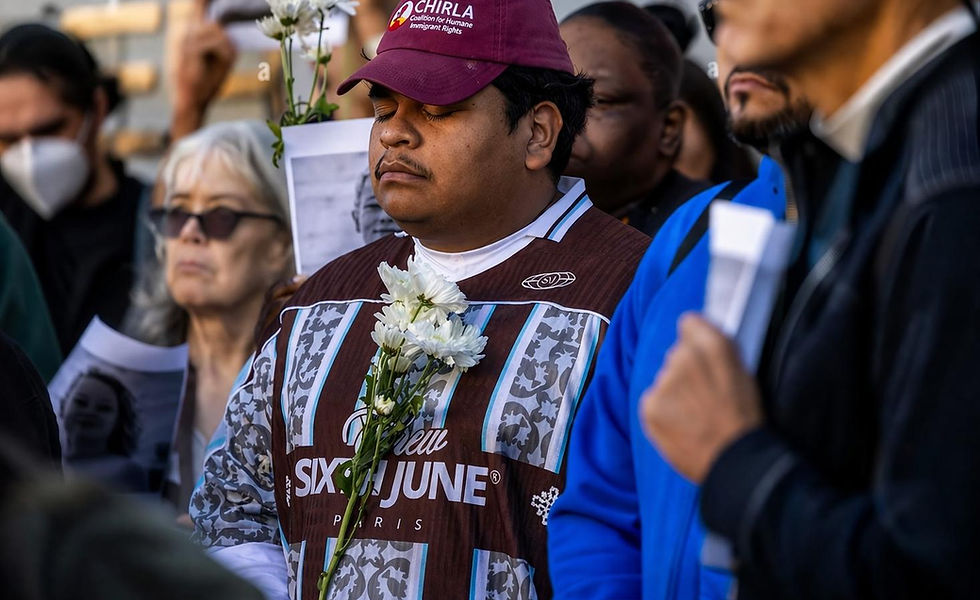
Oscar Zárate prays while wearing a CHIRLA cap during a community blessing at the opening of the No Kings March on Oct. 18, 2025. (Courtesy of CHIRLA Archives.)
The scale of that work reflects the broader stakes of immigrant rights advocacy. Deportations following ICE arrests inside the United States have increased fivefold since 2024, according to a recent analysis by the Deportation Data Project. The report also found arrests have more than quadrupled, driven in part by a sharp rise in street arrests in communities.
As enforcement intensifies, Zarate regularly travels to Sacramento for “days of action,” where advocates meet directly with lawmakers to push for legislation. The coordinated efforts involve training participants, aligning messaging and conducting visits with elected officials to advocate for specific bills.
“We go into the Capitol and have visits with members and tell them what our priority bills are and for them to support them,” he said.
Karen Mestizo, a social systems analyst for Santa Clara County, who has worked with Zarate for over eight years and seen his grassroots organizing efforts in Los Angeles said “having a person like Oscar, who understands strategy and legal processes, being in a position to influence laws is what’s needed, because his lived experience in what he is advocating for is how we get more inclusive laws passed… His transparency and ability to build trust with many people allows him to build a more unified community tackling immigration issues and building community power.”
The work Zarate does requires constant coordination across organizations that don’t always share identical goals. Zarate described coalition spaces as a mix of collaboration and competition, where different groups navigate influence and recognition while working toward shared outcomes.
“Every organization wants to be the one influencing and moving,” he said. “I have to think about how all these interests come together.”
Despite the complexity, Zarate said the work remains motivating, even on difficult days. Rather than discouraging him, challenges often reinforce his commitment.
“I think I’m naturally very motivated by challenges,” he said. “When something is hard… it makes me want to work on it more.”
Sustaining that work, he added, requires balance outside of organizing. To him, time with friends, rest and maintaining a routine help him to continue to show up in high-pressure environments.
At its core, Zarate’s approach to advocacy is grounded in long-term commitment rather than short-term recognition. He said finding work that aligns with personal values has been key to maintaining that focus.
“Once you find something that is your thing, then it doesn’t really feel like work,” he said. “I would naturally want to be doing this.”