
Kelowna's Short-Term Rental Crackdown 'Worked,’ But for Who?
- May 4
- 5 min read
Updated: May 6
By Hermes Padilla, Emerson College

The Movala in Kelowna, B.C., is a two-tower development with 10 and 14 stories in the South Pandosy neighborhood overlooking the Okanagan Lake. When it was announced, it was pitched as housing for a city that couldn't build fast enough, with Kelowna having been named the fastest-growing Census Metropolitan Area (CMA) in Canada, with a 14% population increase between 2016 and 2021. But if you walk past the development today, the listings tell a different story. With current price tags of $849,000 for a two-bedroom and rising to $1.449 million for a three-bedroom unit, the real question is who these developments were constructed for and if they were developed to be utilized as short-term rentals.
Camilla Holm, a 32-year-old neighbor living two blocks from the development, attests they were never meant to be homes to long-term residents of Kelowna. "The units in the development, like others, were going to be used by a lot of investors to rent, like Airbnb. But because of the ban, people are taking losses."
British Columbia's Short-Term Rental Accommodations Act took effect in May 2025, restricting Airbnbs and Vrbos to principal residences across 65 communities covering most cities of more than 10,000 people. The goal was to return housing to the long-term rental pool.
In Kelowna, the results looked like a policy triumph. The rental vacancy rate jumped from 3.8% in 2024 to 6.4% in 2025. By December 2025, Kelowna was the only municipality in the province to meet the threshold for an exemption. The city had two consecutive years above 3% vacancy, as measured by Canada Mortgage and Housing Corporation data, leading to the providence being granted an accelerated exemption effective June 1, 2026.
With vacancy rates rising after a slowdown in population growth and a surge in new development, the question remains whether these new units are sitting empty because they are unaffordable for average-income residents in Kelowna.
The City of Kelowna’s 2040 Official Community Plan (OCP) and Housing Action Plan is aimed at facilitating the construction of approximately 45,000 new housing units by 2041 to meet population growth and demand. However, the ambitious goal might be wrongly calculated if population growth has been halted.
In January 2026, Statistics Canada confirmed Kelowna's population growth had collapsed to 1.2%—the lowest of the decade, down from 3.5% the year before. The greater Kelowna area, which includes West Kelowna, Peachland, and Lake Country, added just 2,957 people, reaching 254,605. That is a fraction of the nearly 8,000 who arrived in 2022, the 6,100 in 2023, or the 5,600 in 2024.
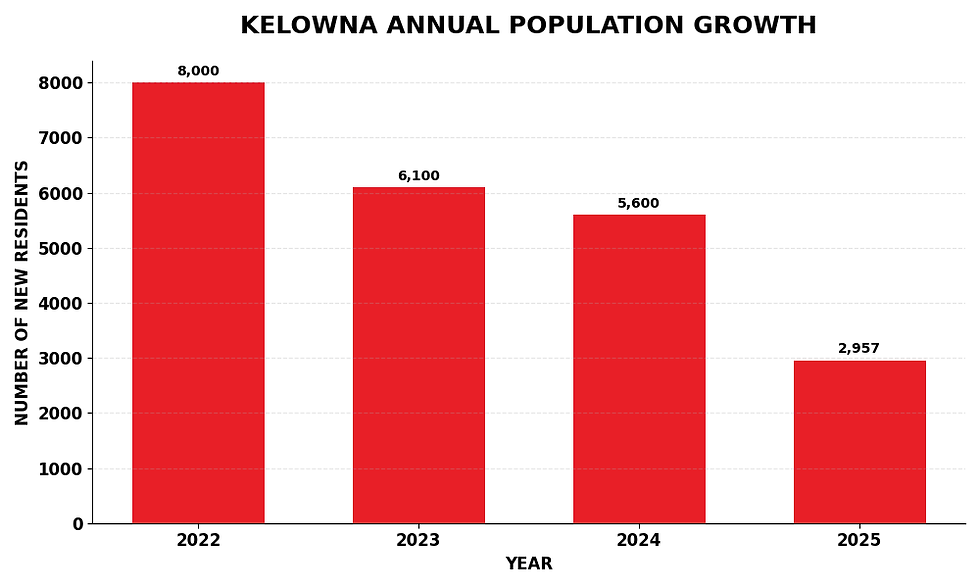
Additionally, international migration, which brought nearly 4,000 people to the region in 2023, fell to just 1,108. Canadians moving west for opportunity also declined, with only 646 people migrating to Kelowna in 2025. Kelowna, which the 2021 Census ranked as Canada's fastest-growing city, has fallen to the middle of the pack. Edmonton now leads the country at 3%, followed by Moncton and Calgary at 2.9%.
Camilla, being an immigrant to Kelowna from Sweden, first moved to the city in 2018, drawn by the hiking, the lake views and the laid-back community of people hanging out outdoors after work. Her partner, Jorden Puzzella, 37, relocated from Ontario for the weather and career mobility. "The nice weather and the ability to move up in my career brought me here," he said.
They share a two-bedroom apartment that Jorden first rented with his brother before Camilla moved in. Their rent has climbed steadily. Their income has grown too, with Jorden’s salary doubling since moving to the city eight years ago. However, it has not grown fast enough. "If housing keeps taking up more of that income, that opportunity starts to feel stagnant," he said.
Camilla put it more bluntly. "When I first moved here, buying a home felt realistic. Now prices have doubled, and now that we started thinking about having a family, we're honestly not sure if owning a home in Kelowna is something we'll be able to do anytime soon, or ever."
The data backs their experience. Despite the highest vacancy rate in Canada, rents in Kelowna continued to rise, with $1,596 averaging for a one-bedroom and $2,118 for a two-bedroom. Turnover rents—the price new tenants actually pay—ran 29% higher than what sitting tenants paid. The median home price for a single-family home sat at roughly $933,000, down from $1,025,000 the year before and condos held steady hovering around $720,000.

Andrew Smith shares a different perspective. Being a realtor with Royal LePage in Kelowna, he is optimistic about the city’s real estate market. He expects buying activity to increase and prices to rise, as stated on his YouTube Channel. "Even when prices dip slightly year over year, demand is still strong, and seasonally, we expect prices to increase again as we move further into the year," he said. "There's been a surge of people moving here, but housing supply hasn't kept up. That imbalance is what's driving long-term pressure in the market."
Now, with summer approaching and units sitting empty, Kelowna is reopening those vacant units to short-term renters for the influx of summertime visitors.

The city’s tourism data shows Kelowna's hotel occupancy has climbed steadily from 46.9% in 2021, 60.03% in 2023 and 66.7% in 2025, according to Kelowna’s Tourism, showing the benefit hotels took from the lack of competition.
Visitor spending per party has flatlined at roughly $1,577 since 2023. The economic impact of tourism in the Central Okanagan reached $2.4 billion in 2022-23, up from $2.1 billion in 2018-19.
Meanwhile, Kelowna’s unemployment rate was 7% as of March 2026, up 0.7% from the previous month. The city that needed to build faster to house its residents has become a city people cannot comfortably afford.
Mix this with the federal immigration slowdown flattening population growth nationwide, with the Parliamentary Budget Officer projecting essentially zero growth in 2026. British Columbia was the only province where the population declined in the first half of 2025.
Kelowna's short-term rental banning policy was built on the assumption that housing scarcity was a supply-side problem, with the assumption that there are too many Airbnbs and not enough apartments. However, the vacancy rate revealed that in a city where population growth has been cut and income earning does not equate affordability, the scarcity wasn't just about available units. It was about who is able to afford to live in them.
The vacancy rate is not a measure of housing abundance. It was a measure of economic attainability.
SOURCES
Kelowna and Central Okanagan, BC Real Estate Price and Market Trends
CMHC Vacancy Rate and Rent Data, 2024-2025 Rental Market Report
Castanet, "Kelowna no longer fastest growing city in Canada," Jan. 17, 2026
B.C.'s Short-Term Rental Legislation - Province of British Columbia
BC Gov News - Housing and Municipal Affairs | Accelerating short-term rental opt-out process
Interviews: Camilla Holm, Jorden Puzzella, Andrew Smith (Royal LePage)


Comments